For many organisations, an S/4HANA programme begins with a technical question:
How do we move from the current SAP environment to the new platform?
That question is necessary, but it is not enough.
A technically successful conversion can still produce a difficult operational environment if architecture, data, integrations, security, downtime, support responsibilities and post-go-live operations are treated as secondary concerns.
This is why S/4HANA transformation should be approached as an operating model change, not simply a migration event.
The strongest programmes do not focus only on getting through cutover. They focus on what the environment needs to look like on the other side: stable, supportable, observable, secure and ready for continued change.
S/4HANA Is Not Just a Migration Project
The word “migration” can make an S/4HANA programme sound linear.
Current system.
Technical conversion.
New system.
Go-live.
Real environments are rarely that simple.
SAP landscapes are connected to external systems, interfaces, identity platforms, databases, middleware, reporting tools, cloud services and business processes that have evolved over many years.
Some dependencies are well documented. Others are known only by the people who operate them every day.
That is why a successful S/4HANA programme cannot be measured only by whether the technical conversion completes.
The more important question is:
Can the new environment operate reliably once the project team steps away?
That requires operational thinking from the beginning.
Start with Technical Readiness, Not the Project Plan
Project plans tend to focus on milestones, workstreams and delivery dates.
Technical readiness focuses on the actual condition of the environment.
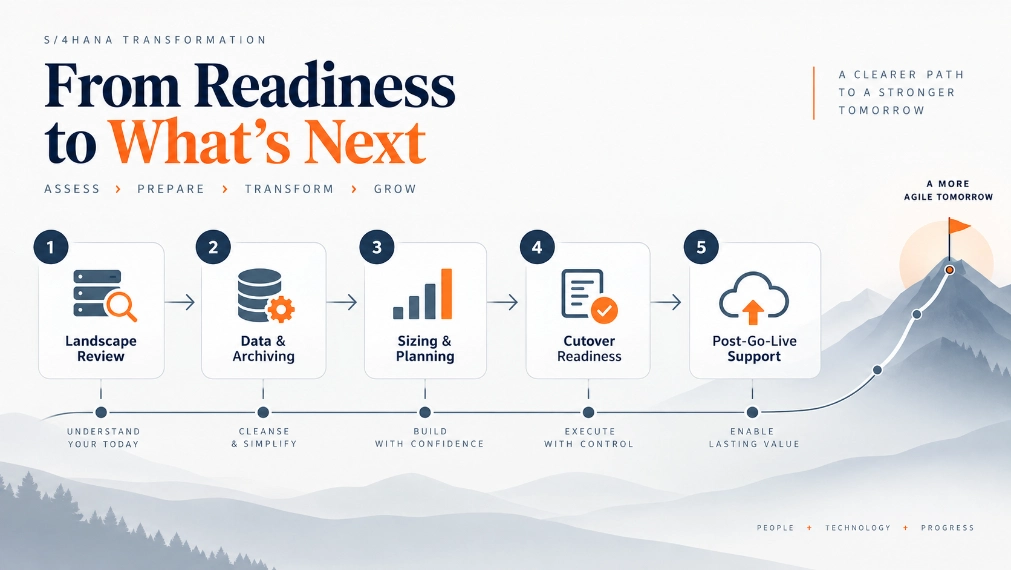
Before committing to a transformation path, organisations need a clear understanding of the current landscape:
- SAP versions and components;
- database and operating system dependencies;
- infrastructure constraints;
- interfaces and external systems;
- custom developments;
- batch workloads;
- backup and recovery design;
- security dependencies;
- data volumes;
- capacity trends;
- and operational pain points.
This is not administrative preparation. It is risk identification.
A system that appears stable in daily operation may contain issues that become significant during conversion.
An old interface may function adequately today but fail under a changed technical architecture. A large database may increase downtime. A fragile batch chain may become more sensitive during cutover. An undocumented dependency can delay testing or create unexpected post-go-live incidents.
A readiness assessment helps expose these issues before the programme becomes dependent on a fixed migration schedule.
Architecture Decisions Shape the Future Operating Model
Architecture is often discussed as a project design decision.
In reality, it determines how the environment will be operated for years afterwards.
Cloud, on-premise and hybrid models create different responsibilities around:
- infrastructure;
- availability;
- performance;
- security;
- connectivity;
- backup;
- monitoring;
- cost;
- support;
- and capacity management.
The right question is therefore not simply:
Where should S/4HANA run?
It is:
Which architecture gives the organisation the right balance of resilience, performance, manageability, security and cost?
This is where SAP infrastructure sizing and capacity planning become critical.
Sizing should not be treated as a one-time estimate based only on current workload.
It should consider:
- expected business growth;
- data growth;
- peak transaction periods;
- future integrations;
- reporting demand;
- non-production environments;
- high availability requirements;
- and transformation-related changes in workload behaviour.
A design that is technically sufficient for go-live may not be operationally efficient six or twelve months later.
Good architecture should work not only on day one, but in steady-state operation.
Data Volume Can Become a Hidden Migration Risk
Data is one of the most underestimated technical factors in SAP transformation.
Over time, SAP systems accumulate:
- transactional history;
- technical logs;
- attachments;
- archived but still accessible records;
- custom tables;
- interface data;
- application logs;
- and business data that may no longer require the same level of online accessibility.
Large data volumes affect more than storage.
They can influence:
- migration duration;
- database conversion time;
- backup windows;
- restore times;
- system performance;
- infrastructure sizing;
- testing cycles;
- and long-term operating cost.
This is why data archiving and data lifecycle management should be considered before, not after, an S/4HANA transition.
The objective is not simply to reduce database size.
It is to decide what data genuinely needs to move into the new environment, how long different data classes should remain active and how future growth will be controlled.
An organisation that carries unnecessary historical data into the target platform may be transferring old operational problems into a new architecture.
Downtime Planning Is a Business Decision
Technical teams often discuss downtime in terms of tools and execution steps.
That is necessary, but incomplete.
Downtime is ultimately a business constraint.
A four-hour technical window may be acceptable for one organisation and impossible for another.
The planning process therefore needs to connect technical activities with business reality.
This includes:
- business-critical periods;
- financial closing;
- logistics operations;
- manufacturing schedules;
- customer-facing processes;
- regional time zones;
- interfaces;
- and downstream systems.
Technical approaches involving tools such as SUM and DMO can help structure the conversion process, but tooling alone does not solve downtime risk.
The programme still needs to understand:
- what must stop;
- what can continue;
- which systems must be synchronised;
- what needs to be validated;
- how rollback would be handled;
- and how long the business can realistically operate without the target system.
This is why rehearsal matters.
A test conversion is valuable not only because it proves that the technical procedure works.
It reveals where time is actually being consumed.
That allows teams to improve sequencing, parallelise activities, refine validation steps and establish a more credible production cutover plan.

Integrations Are Often Where Complexity Hides
S/4HANA rarely operates alone.
It may depend on:
- middleware;
- EDI platforms;
- warehouse systems;
- banking interfaces;
- tax systems;
- reporting platforms;
- cloud applications;
- customer portals;
- supplier systems;
- SAP BTP;
- SAP Cloud Connector;
- and custom applications.
The SAP system itself may convert successfully while an external dependency still causes business disruption.
This is why integration dependency mapping is one of the most important parts of transformation readiness.
Teams need to understand:
- what connects to what;
- which interfaces are business-critical;
- how authentication is handled;
- which endpoints may change;
- which integrations depend on legacy protocols;
- and which third parties need to be involved in testing.
The most dangerous interfaces are often not the most technically complex ones.
They are the ones that have been running quietly for years with limited documentation.
A transformation programme has a useful side effect: it exposes whether integration knowledge is institutional or dependent on individuals.
Security and Identity Must Move with the Landscape
Security work is sometimes pushed towards the end of transformation programmes.
That is a mistake.
A new platform can change:
- technical architecture;
- access paths;
- authentication methods;
- administrative responsibilities;
- cloud connectivity;
- identity integration;
- and audit expectations.
If the organisation simply recreates the old access model in the new environment, it may preserve weaknesses that should have been addressed during transformation.
This is the right time to review:
- roles and authorisations;
- privileged access;
- segregation of duties;
- single sign-on;
- secure communication;
- service accounts;
- technical users;
- identity integration;
- access governance;
- and audit readiness.
Security transformation should happen with the platform, not after it.
This becomes even more important in cloud and hybrid environments, where identity and connectivity boundaries may differ significantly from the legacy architecture.

Post-Go-Live Stabilisation Is Part of the Transformation
Go-live is a major milestone.
It is not the end of the technical journey.
The first weeks of production often reveal behaviours that test environments cannot fully reproduce.
Real business load changes system behaviour.
Users execute processes differently. Batch workloads overlap. Interfaces operate at full volume. Reports consume resources. Background jobs run concurrently. External systems introduce timing dependencies.
This is why post-go-live stabilisation should be planned as part of the programme, not treated as an informal support period.
The stabilisation phase should include structured attention to:
- performance;
- job execution;
- interfaces;
- database behaviour;
- user-reported issues;
- system logs;
- capacity consumption;
- security events;
- and recurring technical patterns.
The objective is not simply to keep the environment running.
It is to move from project mode into a reliable operational model.
Operational Readiness Matters as Much as Technical Readiness
One of the most common transformation gaps appears after the technical team has delivered the new environment.
The system exists.
But who operates it?
A mature S/4HANA programme answers this before go-live.
Operational readiness should define:
- monitoring responsibilities;
- incident ownership;
- patching processes;
- backup and recovery procedures;
- performance management;
- capacity reviews;
- transport governance;
- security operations;
- integration monitoring;
- escalation routes;
- and support boundaries.
Modern platforms such as SAP Cloud ALM can provide stronger visibility across parts of the landscape, but the same principle applies as in day-to-day SAP operations:
A tool does not create an operating model.
People, responsibilities and decision rules still matter.
The support organisation also needs to understand what has changed.
New architecture, new integrations or new operational controls may require different skills.
That makes knowledge transfer and team enablement part of technical readiness.
What Strong S/4HANA Programmes Have in Common
Across complex transformation programmes, several patterns consistently improve outcomes.
Clear Technical Ownership
Critical areas need named ownership.
Architecture, migration, infrastructure, integration, security and post-go-live operations should not depend on informal assumptions.
Realistic Downtime Planning
Downtime targets should be tested, measured and aligned with business constraints.
Optimism is not a cutover strategy.
Validated Architecture
The target design should be evaluated not only for technical compatibility, but for performance, supportability, security and future growth.
Managed Data Volumes
Data growth should be understood early.
Archiving and lifecycle decisions can reduce technical complexity and improve long-term manageability.
Tested Integrations
Critical interfaces should be mapped, tested and validated under realistic conditions.
Planned Stabilisation
The programme should define what happens after go-live before production cutover begins.
Early Involvement of Operations Teams
The people who will operate the environment should not first see it during handover.
Their involvement during design and testing often reveals risks that a project-only view misses.

Common Mistakes to Avoid
Some S/4HANA risks are technical.
Others are created by programme structure.
A few mistakes appear repeatedly.
Treating the transformation as a one-time conversion exercise.
The programme delivers a platform that will need to be operated for years.
Leaving operational teams out until late in the project.
This can create gaps in monitoring, support processes and technical ownership.
Underestimating data growth.
Large data volumes affect more than storage and can influence migration duration, performance and cost.
Assuming the existing security model can simply be reproduced.
A new architecture may require a different identity and access approach.
Ignoring stabilisation planning.
The highest operational pressure often appears immediately after go-live.
Relying too heavily on tooling.
Migration tools, monitoring tools and automation all help, but they do not replace technical judgement or clear accountability.
Beyond Migration: Build an Environment Ready for Change
A successful S/4HANA transformation should create more than a newer SAP platform.
It should leave the organisation with an environment that is easier to understand, operate and evolve.
That means the target environment should be:
Stable — capable of supporting business-critical workloads reliably.
Secure — with clear identity, access and governance controls.
Observable — so operational teams can see what is happening across the landscape.
Supportable — with clear responsibilities, processes and technical knowledge.
Scalable — able to accommodate changes in workload and business demand.
Adaptable — ready for cloud, integration, automation and future SAP capabilities.
The technical migration matters.
But the real value appears after migration, when the new environment becomes part of daily business operations.
An S/4HANA transformation succeeds when the organisation can move from project mode to stable operations without losing visibility, control or confidence.
A successful S/4HANA transformation does not end when the system goes live. It succeeds when the new environment can be operated with confidence from day one and adapted without disruption as the business continues to evolve.
Frequently asked questions
What is the difference between S/4HANA migration and system conversion?
The terms are sometimes used broadly, but a system conversion usually refers to moving an existing SAP ERP environment to S/4HANA while retaining much of the current configuration and business structure. Migration can refer more generally to moving systems, databases, platforms or data into a new target environment. In practice, the technical approach depends on the organisation’s starting point and transformation strategy.
When should S/4HANA technical readiness assessment begin?
Ideally, before the detailed implementation plan is fixed. Early assessment gives teams time to identify infrastructure constraints, data volume issues, integration dependencies, security requirements and operational risks before they begin affecting the project timeline.
How can data archiving reduce S/4HANA migration risk?
Reducing unnecessary active data can decrease database size, simplify migration activities, improve backup and recovery characteristics and potentially reduce conversion and downtime pressure. Data archiving should therefore be considered as part of transformation readiness rather than only as a post-migration housekeeping activity.
Why is post-go-live stabilisation important in an S/4HANA programme?
Production workloads often expose performance, interface and operational behaviours that are difficult to reproduce fully during testing. A structured stabilisation period helps teams identify these issues quickly and establish a reliable steady-state operating model.
What should an S/4HANA operational readiness plan include?
It should define how the new environment will be monitored, supported and maintained after go-live. Typical areas include incident ownership, monitoring, backup and recovery, performance, capacity, patching, transports, security operations, integration monitoring, escalation procedures and knowledge transfer to the teams responsible for ongoing operations.